skip to main |
skip to sidebar
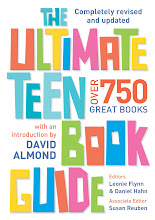
Though this is rather late news (it happened more than a week ago), I did just want to mention how delighted I am that David Almond has won the 2010 Hans Christian Andersen Award. David is of course the author of many wonderful books, and while to my mind the best of them remain Kit's Wilderness and Skellig, I've never read one I didn't like. He's a favourite of all three UBG editors, and we're particularly proud to have him as the author of the introduction to our Ultimate Teen Book Guide.Nikki Gamble, who runs the brilliant Write Away site, asked me last week for a few words on why I thought David was a great choice for the HCAA. So for what it's worth, this was my slightly rambly quote...If you read a lot, you quickly learn that many books are rather like many other books. But this is not always true. David Almond writes books that are unlike anything by anyone else. You can always recognise a David Almond book, and not just the consistent setting, or the familiar way of telling a story, the characters, the prose, but because he seems to see the world quite differently from everyone else. It’s not a fantasy world he lives in, however, it’s not a different world to our own, he merely seems to see things in our own world that the rest of us don’t. And as a result, once you’ve read Kit’s Wilderness, or Skellig, or Clay, you’ll start seeing our world a little differently, too. And really, what more could a reader ask? Almond shows you the things that might be just half-glimpsed out of the corner of your eye, the spirits inside everyday things and places, the shadows lurking behind visible surfaces, the fault-lines between the physical world and the metaphysical, between past and present, life and death. No less than that. His are beautiful books, bold books, they’re books for brave readers who love writing. When we celebrate the pleasure of reading it’s because books allow you to immerse yourself in a world and see it through another’s eyes, and maybe understand something new; when we celebrate the greatness of truly great books it’s because it is these that will deeply change your own perceptions of your own world, and change it, and you, for good. I can think of no one writing for young people today who more deserves celebrating than David Almond.
 It’s really a problem. Tabitha Tumbly and her ghosty friends are obliged to share their house with a family of still-alives (the bearded one, the one with high heels, and the two half-sized ones) who keep doing annoying things like locking the attic door when Pamela Fraidy is inside (and there’s a big leggy spider in there with her – and her a nervous wreck to begin with…). And the worst of it, blubs Wither, is that those still-alives keep being so mean to their ghosty housemates! So Tabitha, Pamela, Wither and their friends come up with a plan to befriend the still-alive family. Unfortunately the still-alives don’t seem very happy to have a troop of ghosties trying to get chummy with them. The ghosties are terribly friendly, frightfully modest, and exceptionally polite (especially Charlie, who always remembers to take off his hat), but those mean still-alives still run screaming every time they see them. How rude!
The family bring in a priest, carrying garlic and a cross ("What does the cross mean?" asked Humphrey. "I think," blubbed Wither, "it means he's cross..."), and the ghosties bring in a big scary Ghoul, and, well, then things really get out of hand...
This is a delightful, really very funny story for younger readers, written by the brilliant Daren King and illustrated with all his customary style by the even-brillianter David Roberts, with whom he’s collaborated before, including on the Nestlé-winning Mouse Noses on Toast. The story is well-told, witty and eccentric, and those fantastic pictures just bring out the best in it – a perfect match.Owing to some shameful mistake by the publishers Roberts isn’t credited on the book, but if lots of us buy copies now they’ll have to reprint it soon and get it right next time. So if you needed another excuse…Recommended by Daniel Hahn
 Oliver Jeffers illustrated and wrote one of my favourite picture books of recent years, Lost and Found, the story of an unlikely friendship between a boy and a penguin. (Other favourites include The Way Back Home and The Incredible Book Eating Boy.) His latest book, The Heart and the Bottle, is no less off-beat, and every bit as charming. It’s the story of a little girl who loves to learn all about the world – the stars, the sea – until one day, she comes over to her father’s chair to show him something she has drawn and finds the chair empty. Her father is no longer there. At that moment she stops feeling wonder at the world, stops marvelling at the beauty of things. Sadly she puts her heart away in a bottle, just to keep it safe…Like Lost and Found this is at least in part a book about loneliness, and its story is supremely well told; and just like the earlier book it finds an ending which doesn’t feel forced or over-sentimental and yet is sweet, is just right. As usual Jeffers’ mixed-media pictures bear slow appreciation – they’re beautiful things (I’m going to have an Oliver Jeffers on my wall one day, just see if I don’t…), sometimes very richly detailed and sometimes expressive with such simplicity, with many lovely, witty discoveries to be made.I have slight doubts, as I occasionally do with Oliver Jeffers’ books, whether they aren’t the sort of lovely picture books that adults adore more than children do – I’m yet to be persuaded that this is a book that young children will be charmed by. But I’m going to ignore that brief cavilling for now, because personally I love it. It’s about grief and love and the whole world – it’s touching, and profound.Recommended by Daniel Hahn
 Lou Bertignac, a thirteen-year-old girl with an IQ of 160, has been moved up a couple of years at school. She is socially awkward and shy, with few friends. The last thing she wants to do is a class presentation. Findng herself put on the spot to identify her topic she blurts out the first thing that comes to mind - the homeless. She will interview the homeless girl, 'No', whom she met at the station. There begins a new friendship and a strong bond between two young girls struggling through life in very different circumstances. No without home or family, Lou with a family that seems to have stopped living. Lou finds herself opening up, not only to No but also to Luke, the older boy in class who seems to like her. Luke quickly becomes her accomplice as she tries to help No.It's a touching and engaging story led by its characters. Lou's narrative walks a delicate balance between being intelligent and beautifully innocent and childlike. I warmed to her instantly, feeling her desire to understand, following her life through thought tangents and experiments, and moments of lostness as she tries to navigate her life in a painful world.No and Me is well written, effortless to read and enjoy while touching on heartbreaking issues of loss, illness, family and social dysfunction. Most of all this is a story of friendship, loyalty, the way people relate to each other and how personal determination and desire to help can make a difference - though not always in the way you expect.Recommended by Tessa BrechinNext?
- Try Make Lemonade by Virginia Euwer Wolff, which explores another supportive yet complex friendship growing from one girl's attempt to help another with her difficult life situation - in this case being a teenage mum of two.
- Or for another unique character-led story, try The Curious Incident of the Dog in the Night-Time by Mark Haddon.
 The Green Man is one of the oldest thematic figures in this country's folklore, and Linda Newbery has taken this motif as a starting point for her new book, Lob.
Lob is an ageless wanderer, who walks the roads till he meets his next special person to whom he will devote himself for the rest of their life. He will work with them as they clear and sow and tend their plants, to bring their gardens stunningly to life. Not everyone can see Lob, but Grandpa Will is one of the lucky ones, and now young Lucy can see him too - so whenever she visits her grandparents, and helps Grandpa Will in his garden, she knows Lob is there with them, helping, too...
Though set in a modern world - urban traffic, waiting lists for city allotments, etc. - there's something timeless about this lovely story, not only in its theme, which links us back to generations past, but also in the telling of it: elegant, sedate, beautifully crafted, filled with a warm kind of hope and old-fashioned charm. It's also an unashamedly poetic, writerly sort of book (for something that is being sold to quite young readers), which in other hands might have weighed it down, but not so here. There are not many writers who could have pulled off a story like this - but Linda Newbery is one of them. Very lovely.
Recommended by Daniel Hahn
 How much harm can a book do? That’s the central question running throughout Sam Mills' new novel, Blackout. It’s a question still playing on my mind.
When Stefan’s father hides the writer of a banned book in their house Stefan finds himself torn between loyalty to his father and to the state. Could it be that his father really is a terrorist or has state authoritarianism just gone too far? Whose side does Stefan want to be on?
An action packed, thought provoking variation on a dystopian idea, with references to many loved classics such as 1984 and Catcher in the Rye as the dangerous books banned in society for fear of triggering teenage terrorist attacks. Such books are rewritten by the state, removing all hint of violence or lust – Lord of the Flies becomes a tale of boys quibbling over sweets! If you haven’t read these books already, you’ll find yourself seeking them out urgently, before it’s too late, before they’re re-written. If you’ve read them before, you’ll want to re-read them just to check they’re as they should be, or perhaps just for the thrill of reading a dangerous book.
A must-read for anyone with a burning desire to read to explore the complexities of life through literature and for those who like to ‘escape’ into a book. It inspires a simultaneous desperation to read everything ever written, while fearing the power of the words contained within those books and reminding you of the uncertain truth of fiction. It felt dangerous to read.
Recommended by Tessa Brechin
Next?
- For another dystopian novel focusing on the impact of censorship on literature try Ray Bradbury’s Farenheight 451.
- Or maybe you’d like to risk reading some of the novels mentioned within the text – 1984, Catcher in the Rye, or Lord of the Flies.
 There’s an awful lot of reality in books for girls: the reality of tower blocks, gangs and the everyday misery of growing up. Boys seem to get guns, spies and saving the world whilst girls get pregnancy, ‘issues’ and boys with fangs – unless of course the book in question has a pink (and sparkly) cover in which case you get girl-meets-boy-plus-misery-before-luv4evah…. But, hang on, the cover of Threads is pink. With sparkles. Does that mean…No, it doesn’t! There’s romance here, yes, but the romance of perfectly cut clothing, of colour and fit and designers who want to make the world more beautiful. There’s the romance of finding what friendship means. The romance of a world where dreams can come true. The romance of a fairy tale – where the wicked witch is the reality of war-torn Uganda and Cinderella is a dyslexic girl in a tutu and fairy wings. It’s also all about the romance of being yourself, regardless of shape, colour or creed. And most of all it’s about love.Sophia Bennett won The Times / Chicken House prize for an unpublished author. That this wasn’t snapped up by some publisher long before the prize is a mystery as the writing is fresh, funny and the story is utterly captivating. There’s a sequel, Boys, Beads and Bangles, coming out in May and I for one am eagerly looking forward to finding out more about Crow, Nonie, Edie and Jenny.Threads also has the best use of a museum in a kids’ book since Charlie Fletcher’s Stone Heart – not the Natural History museum this time, but the glorious Costume gallery next door at the V&A. Go and check them out, as whether you choose to wear a tutu or not, they’re brilliant! Recommended by Leonie Flynn
Next?
• Ballet Shoes by Noel Streatfield – another fairy story for girls who like things real.• The Susanna series by Mary Hogan is about a girl who wants to be a journalist – try Susanna Loves London which has more about the London teen scene, and London fashion too. Or maybe start with Susanna Covers the Catwalk which is about New York fashion week.• They’re pretty much classics now, but you can’t beat Meg Cabot’s The Princess Diaries for girls, friends, and family. Oh, and boys. And a bit of fashion too.